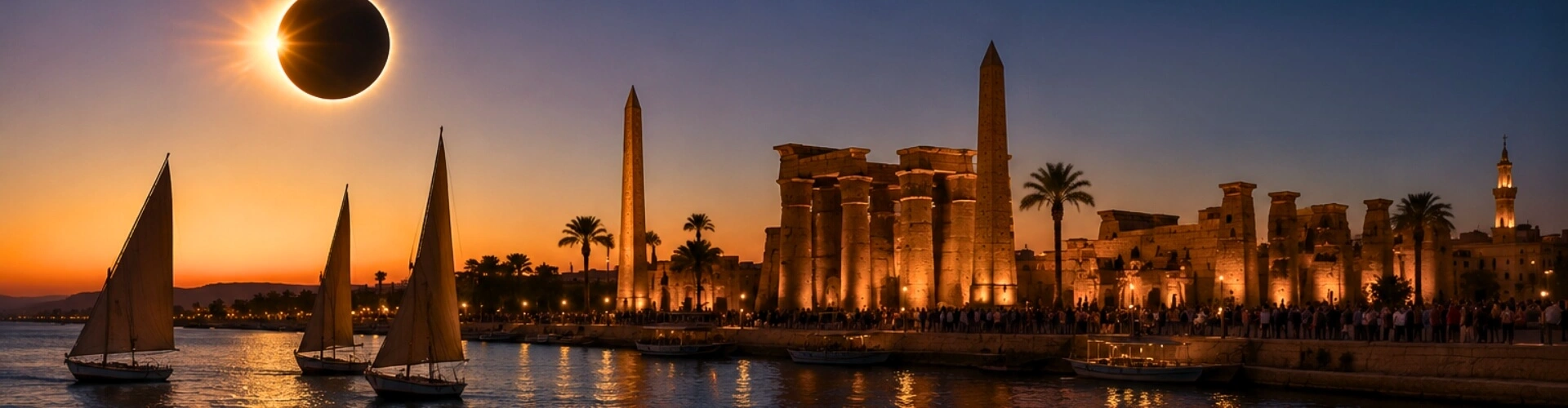
The Last Eclipse Like This Won’t Happen for 87 Years — And It’s Happening Over Luxor
When and where is the 2027 total solar eclipse in Egypt?
On August 2, 2027, totality crosses Luxor for ~6 min 22 sec — the longest total eclipse on land until 2114.
Egypt is about to go dark in the middle of the day. On 2 August 2027, the Moon will fully block the sun over Luxor for just over six minutes, plunging the temples of ancient Thebes into daytime darkness — and the wait for anything like it again will outlast most of our lifetimes. It’s the longest total solar eclipse visible from land anywhere on Earth until 2114, a full 87 years away.
If you’ve been trying to find out when the total solar eclipse in Egypt actually happens, this is it — and it’s close enough now that eclipse chasers, astronomers, and photographers are already planning around it. Egypt sits almost exactly on the path’s centerline, which means the country isn’t just a good place to watch this eclipse — for most travelers, it’s the place.
This guide covers exactly when it happens, why Luxor in particular is drawing so much attention, how the day itself will unfold minute by minute, and what you need to know to watch it safely. As a licensed, Luxor- and Cairo-based tour operator, Egypt Holiday Makers has been fielding early questions about this event for over a year — here’s what we know so far, and what’s still to be confirmed.
1What Is Happening and When?
The 2027 total solar eclipse crosses Egypt on 2 August 2027, with totality over Luxor lasting approximately 6 minutes 22 seconds — the longest total solar eclipse duration on land anywhere until 2114.
Here’s the eclipse broken down by the numbers:
| Detail | Figure |
| Date | 2 August 2027 |
| Totality duration (Luxor) | ~6 minutes 22 seconds |
| Longest duration on the path (desert SE of Luxor) | ~6 minutes 23 seconds |
| Next eclipse this long, anywhere on land | Not until 2114 |
| Path of totality | Crosses North Africa and the Middle East, centered on Luxor in Egypt |
For comparison, most total solar eclipses last only 2 to 4 minutes at best. The 2017 “Great American Eclipse,” for example, topped out at around 2 minutes 40 seconds of totality. Six-plus minutes is close to the physical maximum a total solar eclipse can ever last — which is why this one has earned the nickname “the eclipse of the century.”
A small but important distinction: the single longest point along the entire path — about 6 minutes 23 seconds — falls in the desert just southeast of Luxor, not in the city itself. In practical terms, this makes almost no difference. Anywhere in or immediately around Luxor puts you within a second or two of the maximum possible totality on Earth for this event.
2Why Luxor Is the Best Place to Watch It
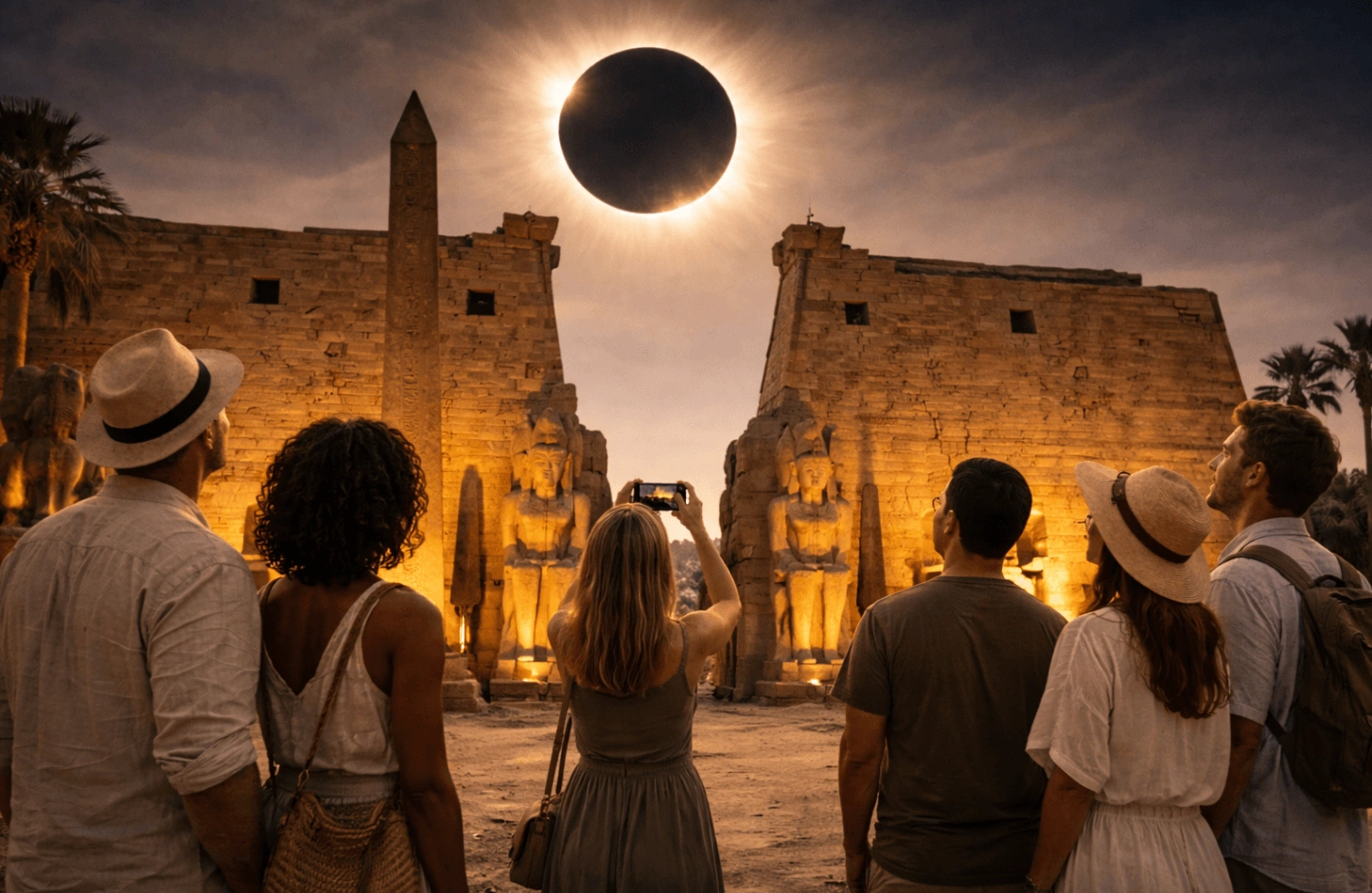
Luxor sits almost exactly on the centerline of the 2027 eclipse path, combining near-maximum totality with clear desert skies and one of the most striking ancient backdrops on the planet.
Three factors make Luxor the standout choice:
- Position on the path. Luxor isn’t near the edge of the path of totality — it’s close to dead-center, which is what gives it (and the desert just outside it) the longest totality duration of the entire eclipse.
- Reliable weather. Upper Egypt in early August is one of the driest regions on Earth, with historically minimal cloud cover. A clear sky isn’t guaranteed anywhere, but Luxor’s desert climate gives it some of the best odds of any location on the eclipse path.
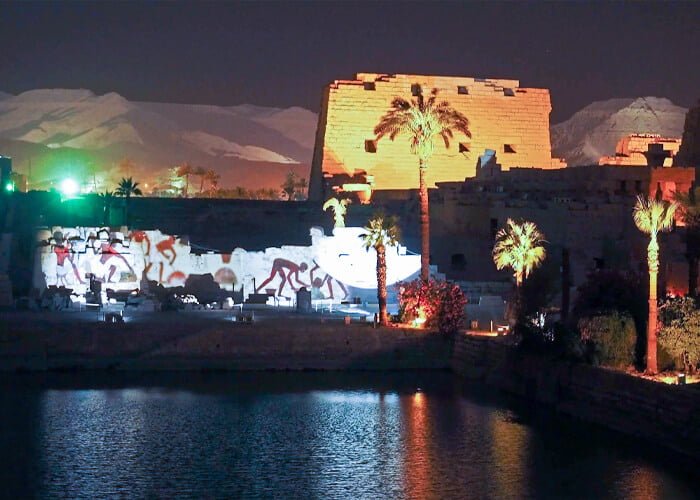
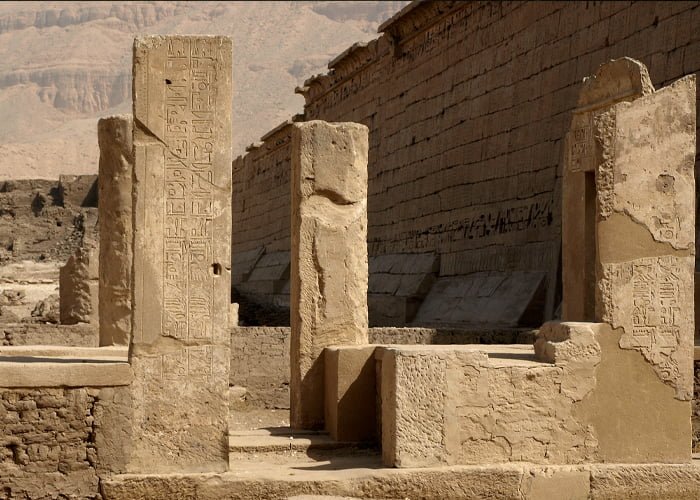
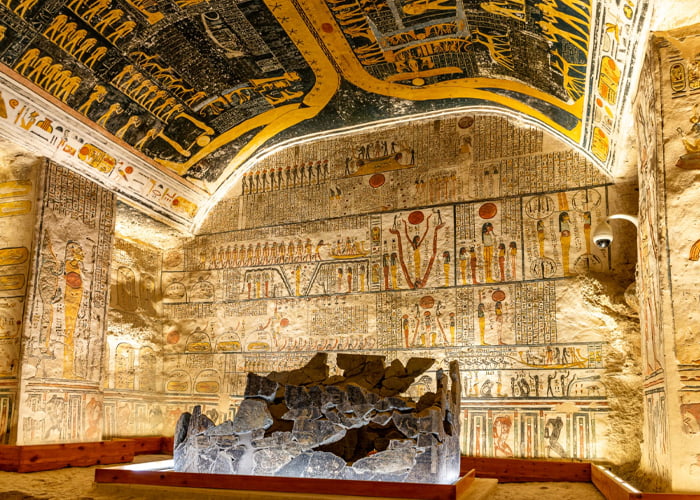
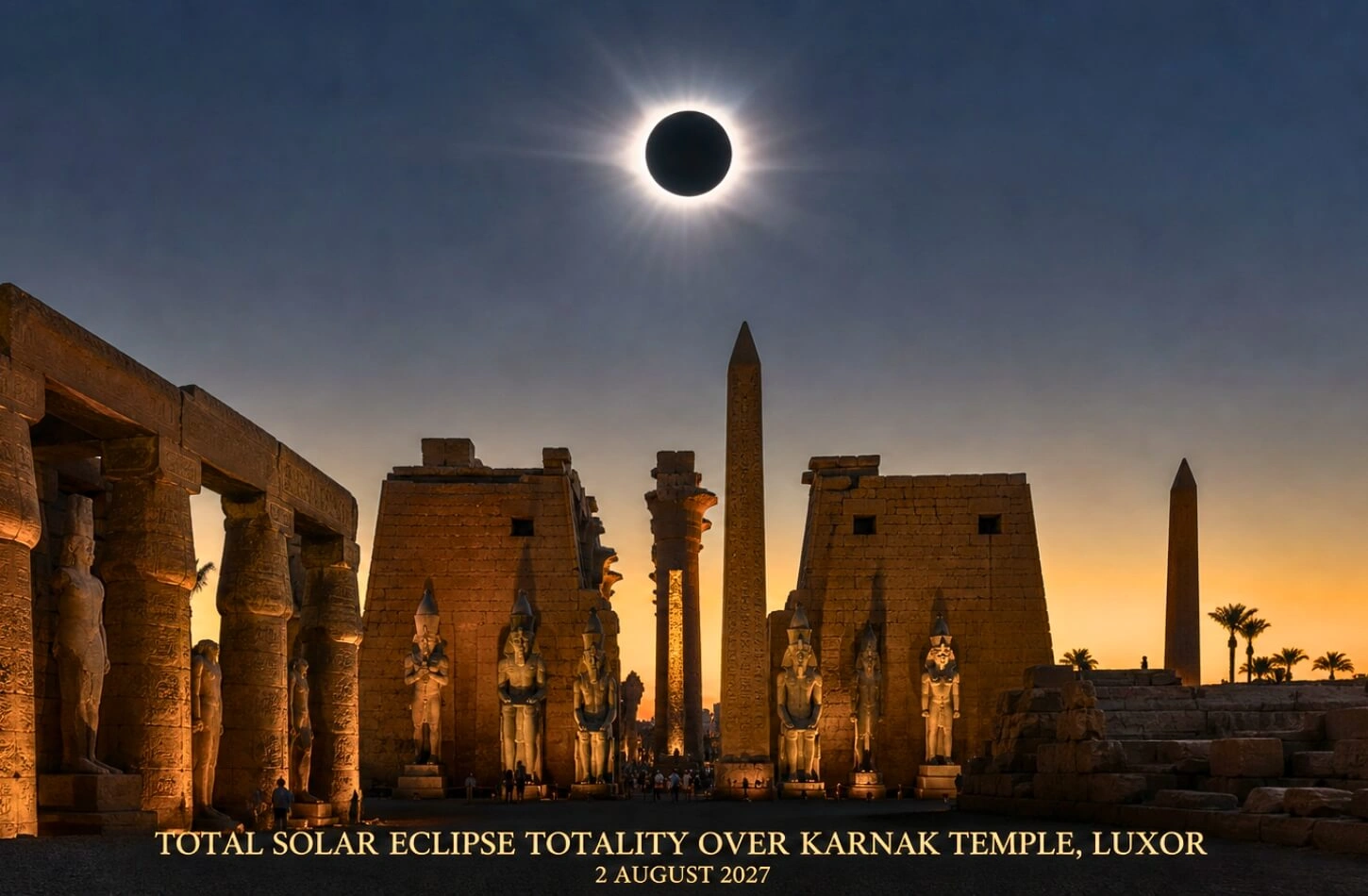
- The backdrop. Few places on Earth let you watch a total solar eclipse above 3,000-year-old temples. Karnak Temple and the Valley of the Kings sit directly under the path, turning a rare astronomical event into a once-in-a-lifetime scene.
3How the Eclipse Day Unfolds
On 2 August 2027, the eclipse in Luxor runs from 11:40 AM to 2:26 PM local time, with the six-minute stretch of full totality beginning at 1:02 PM.
| Stage | Approx. Local Time |
| Partial eclipse begins (first contact) | 11:40 AM |
| Totality begins | 1:02 PM |
| Maximum eclipse | 1:05 PM |
| Totality ends | 1:08 PM |
| Partial eclipse ends (fourth contact) | 2:26 PM |
| Total event length | ~2 hours 46 minutes |
For nearly two hours before totality, the Moon gradually covers more of the sun — daylight dims, shadows sharpen, and temperatures noticeably drop. In the final minute before totality, the sky darkens rapidly, temperatures fall further, and — if the sky is clear — the “diamond ring” effect appears as the last sliver of sun vanishes behind the Moon. Then, for just over six minutes, the sun’s corona becomes visible around a black disk in the sky, stars appear at midday, and it’s briefly, genuinely dark. This is the only point in the entire event when it’s safe to look up without eclipse glasses (more on that below). Then the process reverses over the next 80 minutes as the Moon moves off the sun.
4Where Else in Egypt Is in the Path of Totality?
Luxor sits closest to the centerline and gets the longest totality, but the path of totality is wide enough to cover a stretch of Upper Egypt beyond just the city itself.
Luxor’s position on the centerline is what gets it top billing for this eclipse, and it’s the location most eclipse guides and observatories are pointing travelers toward. Areas along the Nile Valley near Luxor — including desert stretches to the southeast where the path’s true maximum duration occurs — will also experience full totality, just with slightly less precision needed in timing your viewing spot.
Many eclipse-day itineraries also combine Luxor with a stop in Aswan, which sits close enough to make an easy add-on before or after eclipse day, even though it isn’t on the centerline itself.
For nearly everyone planning this trip, though, the practical answer is the same: Luxor is the place to be.
5Choose Your Eclipse Trip
Watching six minutes of totality is unforgettable on its own — but most travelers are turning this into a full Egypt trip built around eclipse day. As a licensed, on-the-ground Luxor operator, Egypt Holiday Makers has built three tour options around the eclipse, each suited to a different kind of traveler. You can see our full range of 2027 eclipse tours here, or use the comparison below as a starting point.
| Tour | Duration | Route | From (price) |
| 8 Days Dahabiya, Luxor to Luxor | 8 days, private | Luxor · Aswan | $7,800 |
| 12 Days Cairo & Dahabiya Cruise | 12 days, private | Luxor · Aswan · Cairo | $9,000 |
| 13 Days Cairo & Dahabiya Cruise | 13 days, private | Luxor · Aswan · Cairo | $9,500 |
- The 8-day Dahabiya trip is the most affordable and time-efficient option — ideal if you want the eclipse and a proper Nile sailing experience without committing two full weeks.
- The 12-day itinerary adds Cairo to the mix, giving you the pyramids and the Egyptian Museum alongside the eclipse and cruise — a good middle ground for first-time visitors to Egypt.
- The 13-day trip is built for travelers who want the fullest possible experience: more time in Cairo, a longer Dahabiya cruise, and a more unhurried pace throughout.
All three tours are built around a Dahabiya Nile cruise — a smaller, more intimate sailing boat than a standard cruise ship, and one of the best ways to be positioned on the Nile itself for eclipse day. If you’re still weighing whether a Nile cruise is worth building into your Egypt trip at all, our breakdown on whether a Nile cruise is worth it covers that in more detail.
All three are private tours, meaning your schedule (including eclipse-day positioning) is built around your group, not a fixed departure list.
Ready to lock in your spot? Message us on WhatsApp — eclipse-week accommodation and Nile cruise availability in Luxor is already tightening, and early booking is the single biggest factor in securing a good viewing location.
6How to Prepare: Eclipse-Viewing Safety and Practical Tips
Never look at the sun without ISO 12312-2 certified eclipse glasses, except during the brief window of full totality — and plan for serious August heat in Luxor, since eclipse day falls near the peak of summer.
Eye Safety
Use ISO 12312-2 certified eclipse glasses for every part of the partial phases — before totality begins and after it ends. Regular sunglasses, no matter how dark, are not safe.
The only time it’s safe to view the sun directly without glasses is during the roughly 6 minutes of full totality, when the sun’s disk is completely covered.
Never view the sun through an unfiltered camera, phone, or telescope lens — this can damage both your eyes and your equipment. Solar filters exist specifically for cameras and telescopes; a regular lens cap or sunglasses taped over a lens is not a substitute.
Photography
If you’re photographing the eclipse, get a dedicated solar filter for your camera in advance — they sell out as eclipse dates approach.
Practice your camera settings ahead of time. You’ll have roughly six minutes of totality, and it goes fast.
The Heat — Be Honest With Yourself About This One
Early August is peak summer in Luxor, and this is worth taking seriously rather than glossing over — see our full summer in Egypt guide for what the season is really like beyond eclipse day. Daytime highs commonly reach 40–43°C (104–109°F), and the eclipse itself happens right around 1 PM — close to the hottest part of the day. A few practical points:
- Hydrate well before, not just during. Start drinking water well ahead of eclipse time rather than trying to catch up once you’re already in the sun.
- Seek shade whenever you’re not actively viewing. You’ll likely be waiting outdoors for close to two hours before totality even begins — plan for shade, a hat, and light, breathable clothing during that stretch.
- Watch for signs of heat exhaustion — dizziness, nausea, or stopping sweating are signs to get into shade and cool down immediately, not push through.
- Book accommodation with realistic expectations — the excitement of eclipse day is real, but so is an Upper Egypt summer afternoon. A good local operator will build in shaded waiting areas and timing that limits unnecessary midday exposure.
Booking
- Eclipse-week hotels and Nile cruise cabins in Luxor are a fixed, limited supply against a global audience of eclipse chasers — booking early matters more here than for a typical Egypt trip.
- For a full packing list beyond eclipse gear, see our guide on what to pack for Egypt.
Related Reading
7Frequently Asked Questions
Q1: When is the next total solar eclipse in Egypt?
A: The next total solar eclipse in Egypt occurs on 2 August 2027, with totality passing directly over Luxor.
Q2: How long will totality last in Luxor in 2027?
A: Totality in Luxor will last approximately 6 minutes 22 seconds, with the absolute maximum of the entire eclipse path (6 minutes 23 seconds) occurring in the desert just southeast of the city.
Q3: Is Luxor the best place to see the 2027 solar eclipse?
A: Yes — Luxor sits almost exactly on the eclipse’s centerline, giving it near-maximum totality duration, historically clear desert skies, and a backdrop of ancient temples found nowhere else on the eclipse path.
Q4: What time does the eclipse start in Luxor on August 2, 2027?
A: The partial eclipse begins around 11:40 AM local time, with full totality starting at approximately 1:02 PM and lasting until about 1:08 PM.
Q5: Why is the 2027 eclipse called “the eclipse of the century”?
A: It’s called this because its totality duration — over 6 minutes — is the longest visible from land anywhere on Earth until 2114, making it one of the longest total solar eclipses most people will ever have the chance to see.
Q6: Do I need special glasses to watch a total solar eclipse?
A: Yes — ISO 12312-2 certified eclipse glasses are required for all partial phases of the eclipse; it is only safe to view the sun without them during the brief minutes of full totality.
Q7: What’s the difference between a partial and a total solar eclipse?
A: In a partial eclipse, the Moon covers only part of the sun and the sky never fully darkens; in a total eclipse, the Moon fully covers the sun for a short window, revealing the sun’s corona and briefly turning day into night.
Q8: Where can I book a 2027 eclipse tour in Egypt?
A: Egypt Holiday Makers offers three private eclipse tour packages ranging from 8 to 13 days — you can view the full range and book your eclipse trip with a local Luxor operator on our dedicated 2027 eclipse tours page.
8Final Thoughts: Don’t Wait to Plan for This One
Eclipses this long don’t come around often — the next one to match it is 87 years away, in 2114, well beyond any of our lifetimes. Luxor’s combination of near-maximum totality, reliably clear August skies, and a backdrop of temples built thousands of years before anyone understood what an eclipse even was makes this one of the rarest travel opportunities most people will ever get to plan around.
If you’re serious about being there, the two things that matter most are booking your accommodation and cruise dates early and building your itinerary around a local operator who already knows the ground. Book your eclipse trip with a licensed Luxor operator or message us directly on WhatsApp to start planning.
Ready to plan your Egypt trip? Let's find your perfect dates.
A local expert replies within hours with a tailor-made itinerary and honest advice.