Egyptian Animal Gods: The 8 Sacred Animals and Where to Find Them Today
By Egypt Holiday Makers | Last Updated: Abril 2026
Every time I walk a client through the temples of Karnak or the painted corridors of the Valley of the Kings, the questions come at the same point — standing in front of a wall covered in gods with animal heads, half human and half beast, staring back across four thousand years. Who are they? What do the animals mean? Why did the ancient Egyptians see the divine in a falcon, a jackal, a crocodile?
These are some of the best questions you can ask in Egypt, and answering them properly transforms what you see. A wall painting stops being decoration and becomes a story. A carved relief ceases to be stone and becomes theology. Understanding the Egyptian animal gods is key to unlocking ancient Egypt — and in this guide, I want to share everything I have learned about them over years of bringing travelers face-to-face with these extraordinary creatures and the gods they represent.
1Why Did Ancient Egyptians Worship Animals?
The ancient Egyptians were among the most observant people in history. They watched the natural world with keen attention—the falcon’s precision in the sky, the crocodile’s dominance over the Nile, the silent ferocity of the cat in the granaries, and the jackal’s habit of prowling around the edges of tombs at dusk. What they saw in animals were qualities they considered divine: strength, protection, wisdom, mystery, and the power over life and death.
In ancient Egyptian religion, animals were not merely symbols; they were understood as living manifestations of the gods—channels through which the deity could be present in the physical world. Temples throughout Egypt housed sacred animals as living representatives of their patron deity. The Apis bull was kept in a dedicated shrine in Memphis, fed, cared for, and consulted as an oracle. Crocodiles at Kom Ombo were adorned with jewels and gold. Cats throughout Egypt were protected by law—harming them, even accidentally, was a crime punishable by death.
When the ancient Egyptians gazed upon a falcon soaring above the Nile Valley, they were not merely seeing a bird; they were seeing Horus—the sky god, protector of the pharaohs, lord of all living beings—watching over them. It was this cosmic vision that built the pyramids, filled the temples with color, and produced one of the most enduring civilizations in human history.
2The 8 Sacred Animals of Ancient Egypt — A Complete Guide
1- Anubis — The Jacka
Role: God of mummification, burial, and the afterlife
Where to see him: The Egyptian Museum in Cairo, the tomb of Tutankhamun in the Grand Egyptian Museum, and in almost all the royal tombs in the Valley of the Kings.
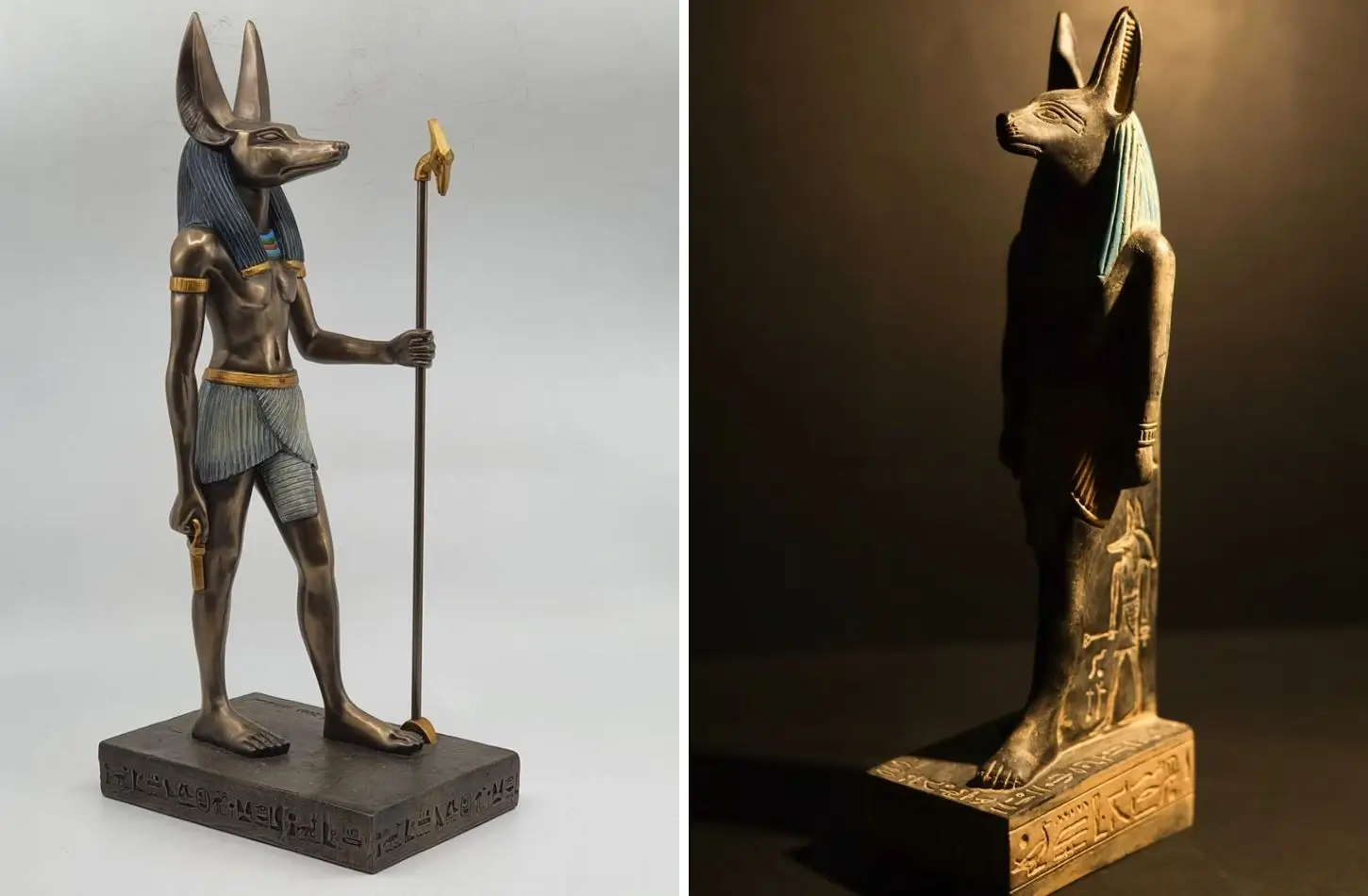
Anubis is the god I introduce to most of my clients before we enter the Valley of the Kings, because once you know him, you see him everywhere. He is depicted as a man with the head of a black jackal, or sometimes as a reclining jackal, as in the famous guardian statue in Tutankhamun’s tomb.
The jackal was chosen to represent Anubis for a reason that was both practical and profound. Jackals were frequently seen on the edges of the desert, near the tombs where the ancient Egyptians buried their dead. Rather than interpreting this as an omen of bad luck, the Egyptians saw the jackal as a natural guardian of the deceased, a creature that truly inhabited the boundary between the world of the living and the world of the dead.
Anubis oversaw all stages of the mummification process. He was believed to oversee the mummification process, the wrapping of the body, and the guiding of the soul through the Duat—the Egyptian underworld—to the Hall of Truth, where the deceased’s heart was weighed against the feather of Ma’at. His black color was not associated with death in its negative sense, but rather with the fertile black soil of the Nile—the color of rebirth and renewal.
Where will you encounter Anubis on your trip to Egypt? His image adorns the walls of most royal tombs in the Valley of the Kings. The gilded shrine of Anubis in Tutankhamun’s tomb is one of the most prominent artifacts in the Grand Egyptian Museum. On our tours of Luxor, Anubis is one of the first deities we mention—he is the guardian of everything you will see.
2- Horus the Falcon
Role: God of the Sky, King, and Divine Protection
Where to See Him: The Temple of Horus at Edfu, the Temple of Karnak, and the walls of virtually every pharaonic monument in Egypt.
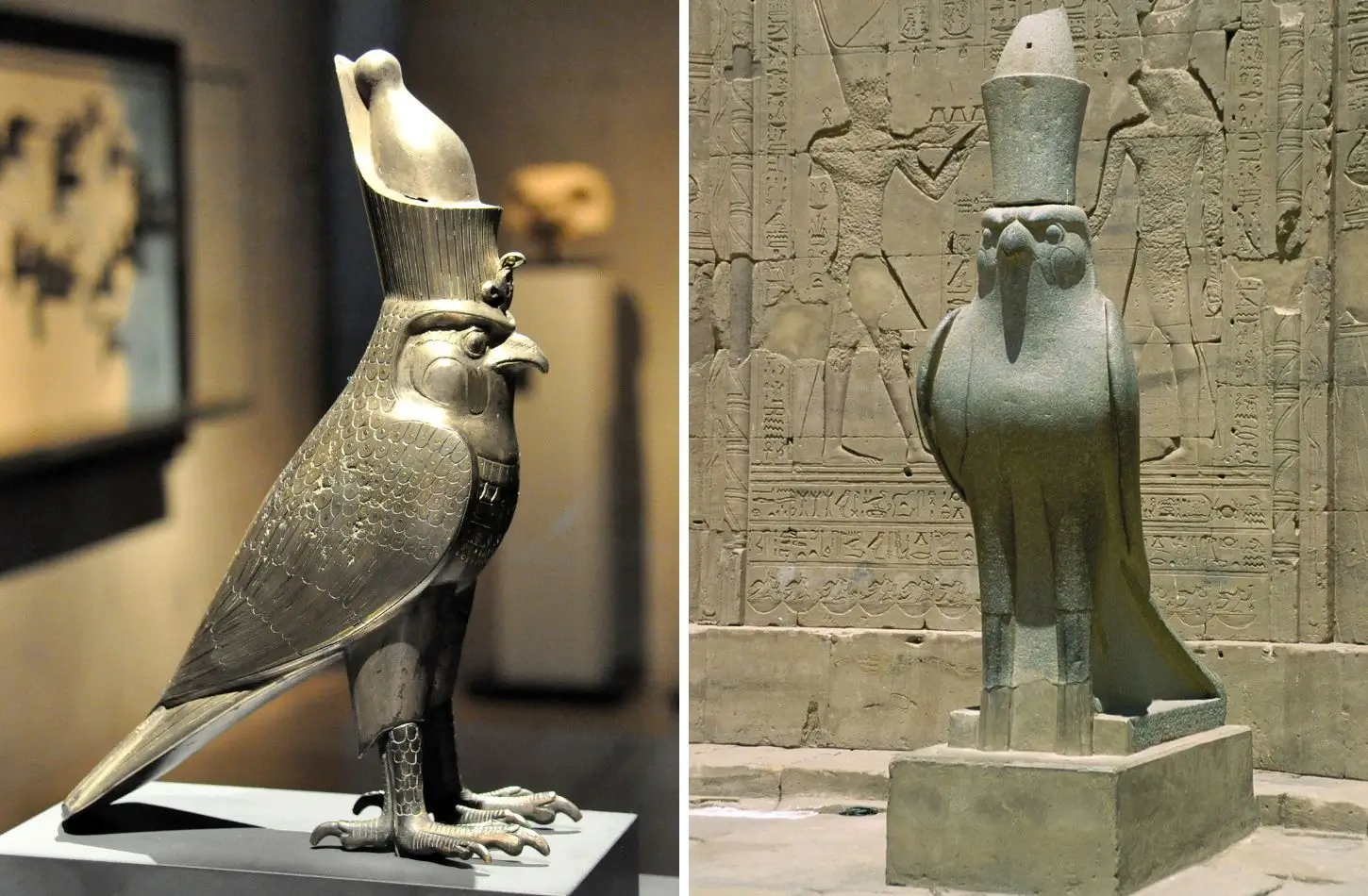
If there is one Egyptian animal deity that every visitor encounters, it is Horus. His image—a man with the head of a peregrine falcon, wearing the double crown of Upper and Lower Egypt—appears on temple walls, in museum collections, and in jewelry stores throughout the country. He is the god who looks down at you from almost every royal cartouche.
The falcon was chosen to represent Horus because of qualities that any Egyptian who had witnessed a single hunt would immediately understand: extraordinary eyesight, speed, precision, and absolute dominion over the sky. The sky itself was Horus—his right eye was the sun and his left eye the moon, traversing the heavens with every rotation of the earth.
The pharaohs were seen as the earthly incarnation of the god Horus in their lifetimes, and of Osiris—Horus’s father—in their deaths. Every pharaoh who ruled Egypt bore the name Horus as the first of his five royal titles. When you see a pharaoh depicted in a temple relief, the falcon soaring above his head is not merely decorative; it is a theological symbol representing the divine nature of his kingship.
Where will you encounter Horus on your trip to Egypt? The Temple of Horus at Edfu, on the west bank of the Nile between Luxor and Aswan, is the best-preserved temple in Egypt and is entirely dedicated to this god. The two colossal falcon statues flanking the entrance are among the most photographed landmarks in the country. We include Edfu in all our Nile cruises, for standing before these statues offers a tangible and immediate glimpse into the grandeur of ancient Egyptian religious beliefs.
3- Bastet – The Cat
Role: Goddess of the home, fertility, music, and protection
Places to see: Egyptian Museum in Cairo, Bubastis ruins in the Nile Delta, and Saqqara
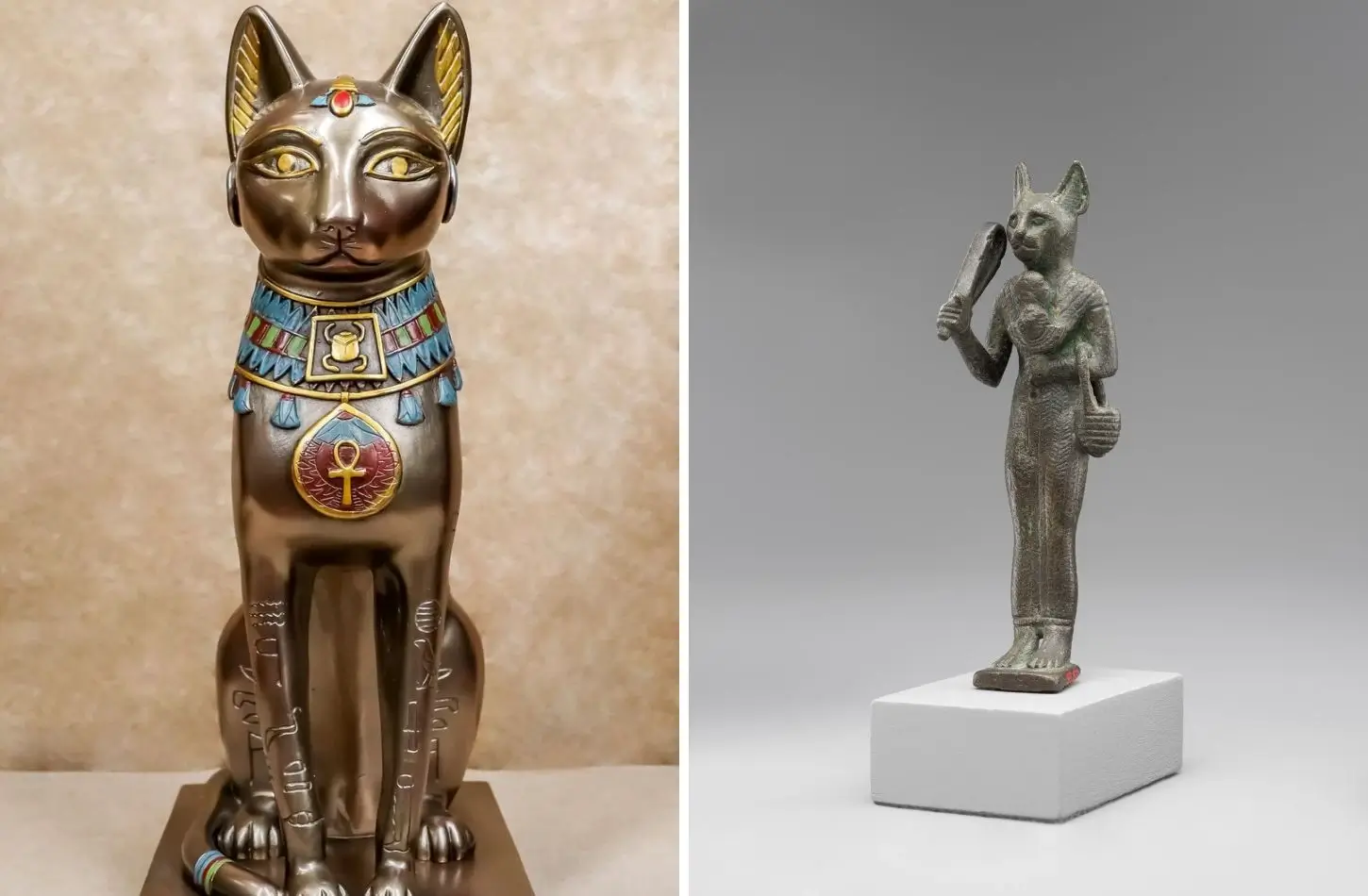
Of all the Egyptian animal deities, Bastet is perhaps the most beloved, and her influence extends far beyond the ancient world. The modern world’s love of cats has deep roots in Egypt, where domestic cats first entered human homes and were given a divine status.
In her earliest form, Bastet was depicted as a lioness—fierce, protective, and majestic. As the centuries passed and domestic cats became increasingly important in Egyptian family life, her image softened, more often appearing as a seated cat or a woman with a cat’s head. This distinction is important: as a lioness, Bastet was dangerous and warlike. As a domestic cat, she was the protector of the home, a goddess of music and dance, and a patron of women and children.
Cats in ancient Egypt gained their sacred status thanks to a practical gift: they deterred rats and snakes that threatened granaries and homes. Their silent efficiency, mysterious independence, and habit of sitting motionless with eyes that seemed to see in the dark—all this made them appear divine to the Egyptians who observed them. Killing a cat, even accidentally, was punishable by death under Egyptian law.
Where else might you encounter Bastet on your trip to Egypt? The Egyptian Museum in Cairo houses a remarkable collection of Bastet statues and cat mummies. And in Saqqara, a cat necropolis was discovered containing thousands of mummified cats that were offered as sacrifices to the goddess. We regularly include the Saqqara site in our daily tours of Cairo – it offers a completely different perspective on Egyptian animal worship compared to what you see in Giza.
4. Thoth – The Ibis
Role: God of wisdom, writing, knowledge, and the moon
Places of depiction: Tomb of Seti I in the Valley of the Kings, Karnak Temple, and the ruins of Hermopolis near Minya.
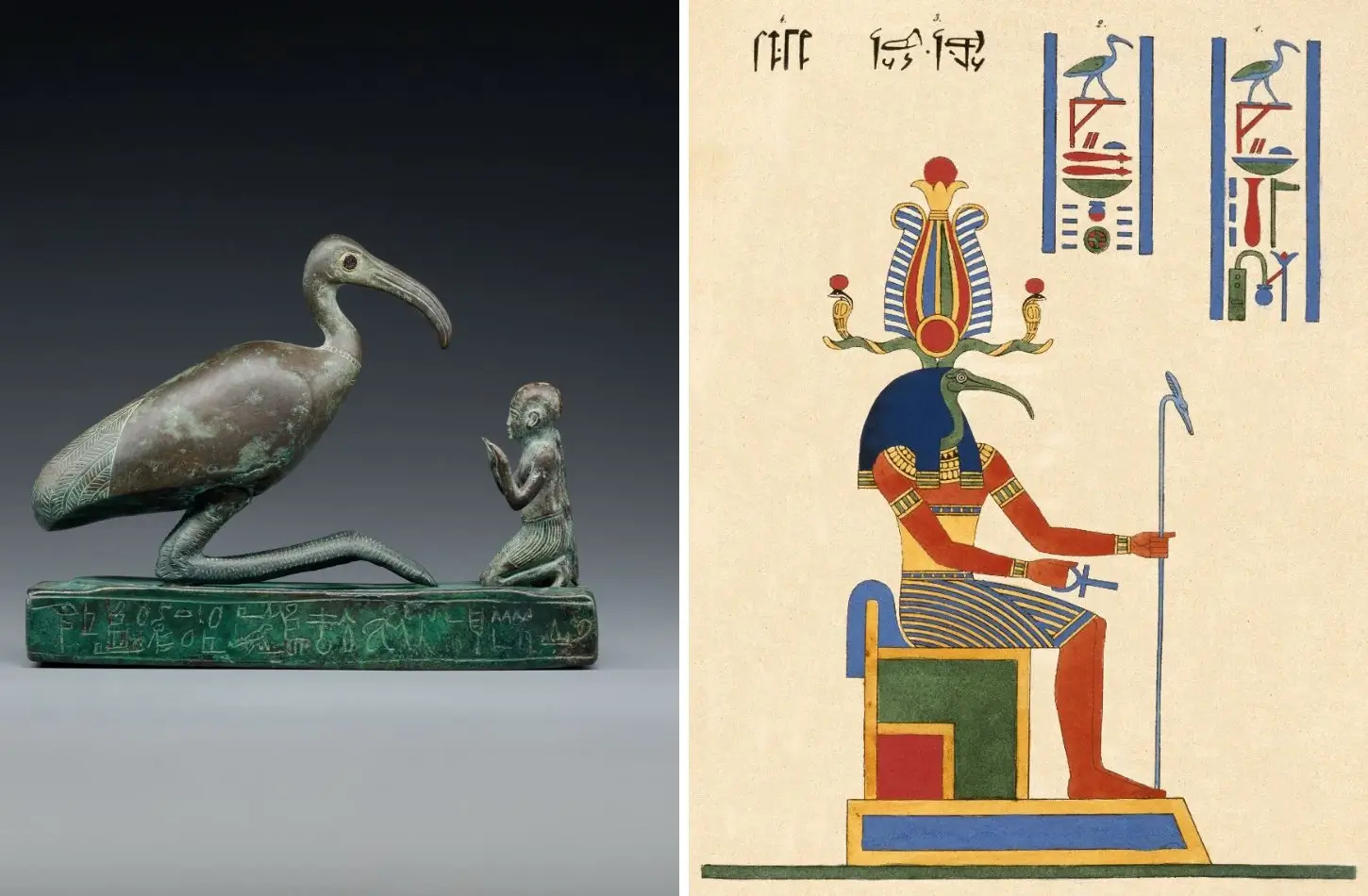
Thoth appears in the form of the sacred ibis, a bird with a distinctive hooked beak and black-and-white plumage, a common sight along the banks of the Nile. The ibis was believed to embody Thoth’s divine nature as a scribe, record-keeper, and moon god, as its hooked beak resembles a crescent moon.
As the god of wisdom and writing, Thoth was one of the most important figures in Egyptian mythology. He is believed to have invented hieroglyphic writing, the writing system that enabled ancient Egyptians to record their history, religion, and sciences on stone for thousands of years. In the Hall of Judgment, where the dead were judged, Thoth recorded the verdict when the heart was weighed against the feather of Ma’at.
Ibis were mummified in enormous numbers as offerings to Thoth. Archaeologists have discovered sites in Saqqara and Abydos containing hundreds of thousands of mummified ibises, carefully wrapped and placed in pottery jars or wooden boxes. The scale of this worship is astonishing even by the standards of ancient Egyptian religious practices.
Where will you encounter Thoth on your trip to Egypt? Thoth appears throughout the painted burial chambers of the Valley of the Kings, accompanying texts from the Book of the Dead and the Book of Amduat. The tomb of Seti I contains some of the most remarkable depictions of him as an ibis. We include the Valley of the Kings in all our Luxor itineraries, and Thoth is always part of the conversation.
5- Sobek – The Crocodile
Role: God of the Nile, Power, Fertility, and Protection
Places to see: Temple of Sobek at Kom Ombo, Crocodile Museum at Kom Ombo, and Fayoum
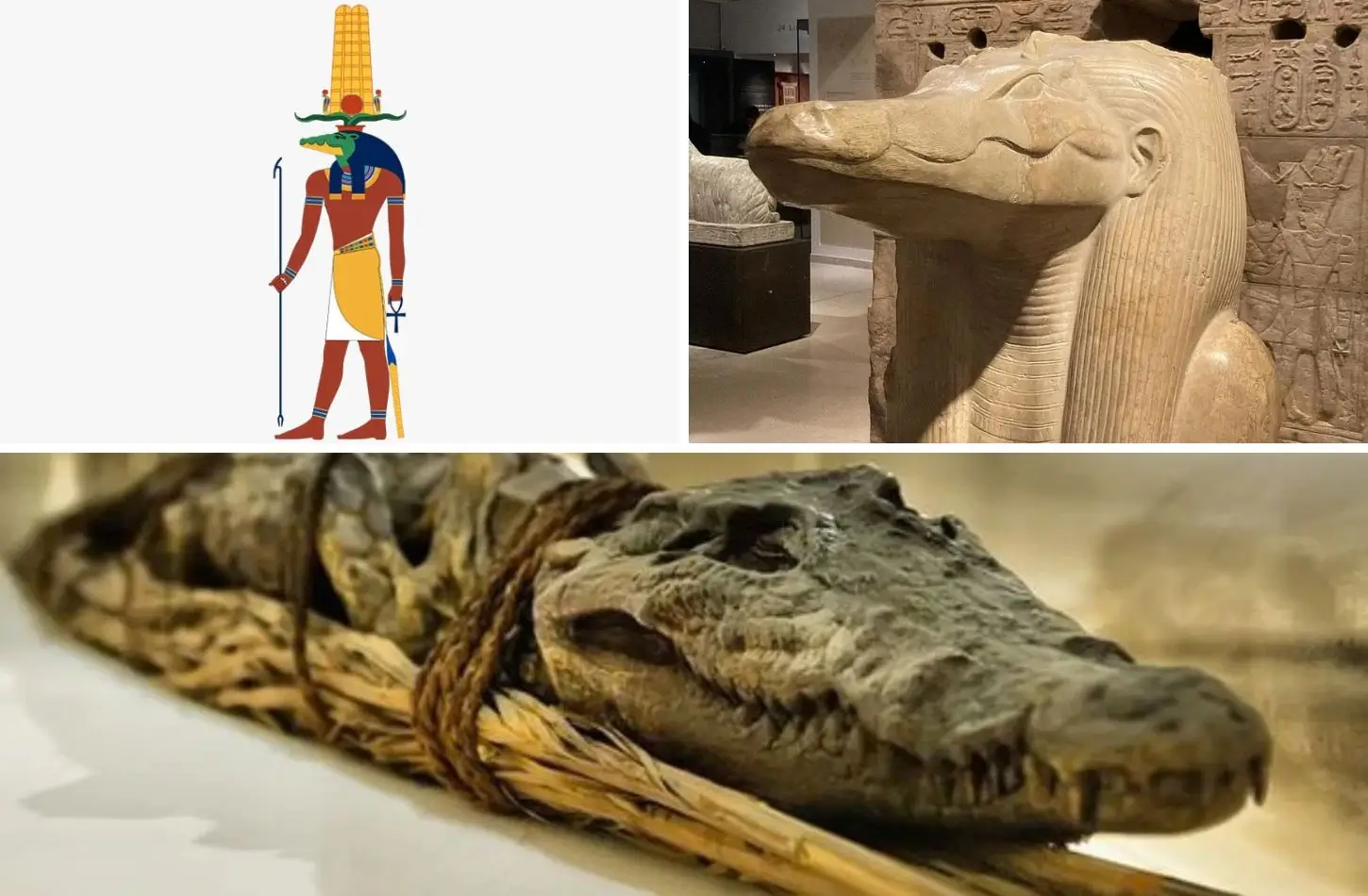
Few Egyptian animal deities embody the duality of ancient Egyptian religious thought as clearly as Sobek. The Nile crocodile—one of the most dangerous animals in Africa, a creature capable of killing a bull or capsizing a boat—was both feared and worshipped. The Egyptians understood that the crocodile could only be appeased with reverence, not hostility. Thus, the crocodile became a god.
Sobek was depicted as a man with a crocodile’s head, wearing a solar disk and horns. The Nile itself was his domain—the source of Egypt’s agricultural fertility, its trade route, and the most dangerous waterway its people crossed daily. As the god of the Nile’s power, Sobek was also the god of the pharaoh’s military might. Before going into battle, soldiers would invoke Sobek’s power.
In his temples, live crocodiles were kept as living embodiments of the god and fed meat, wine, and honey. She was adorned with gold jewelry and crystal earrings. When she died, she was mummified and buried in lavish funerals—dozens of these mummies still exist and can be seen today.
Where you will encounter Sobek on your Egypt trip: The Temple of Kom Ombo, set on a dramatic bend in the Nile between Luxor and Aswan, is jointly dedicated to Sobek and Horus — the only double temple in Egypt. The adjacent Crocodile Museum displays a remarkable collection of mummified crocodiles recovered from the site. Kom Ombo is a stop on all our Nile cruise itineraries, and it is consistently one of the most memorable visits of any Egypt trip.
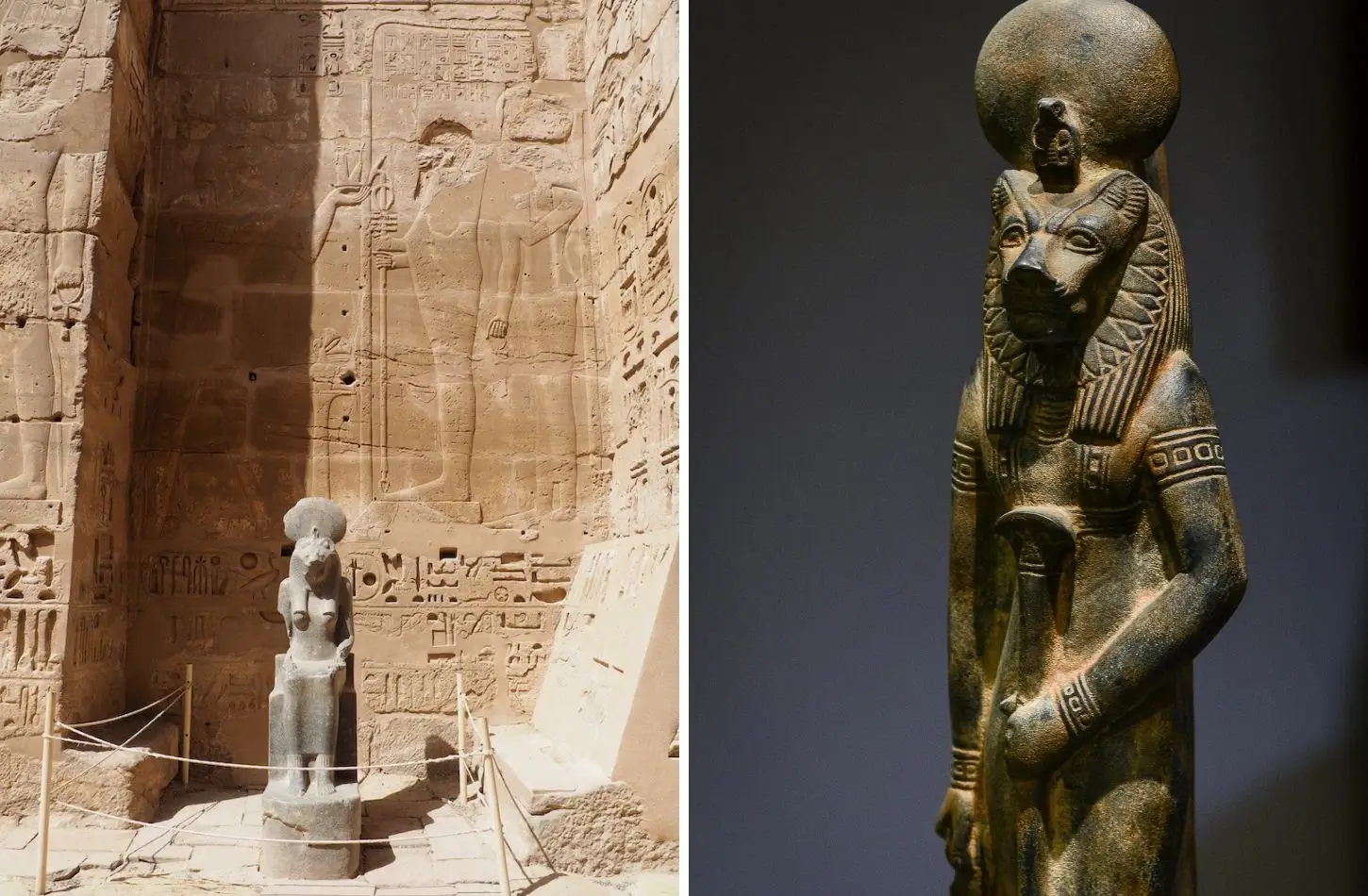
6- Sekhmet – The Lioness
Role: Goddess of War, Destruction, Healing, and Medicine
Places to see: Egyptian Museum in Cairo (famous Sekhmet statues), Karnak Temple, and the Temple of Mut at Karnak.
Sekhmet is considered the most powerful of the ancient Egyptian animal deities. A lioness-headed goddess, she embodies the destructive power of the desert sun and the healing arts that can reverse its devastating effects. Her name means “the mighty one,” and the ancient Egyptians understood her as a being capable of both sending and curing plagues—a goddess feared and desperately invoked in times of illness.
Her mythology is based on a story of divine wrath and redemption. Ra, the sun god, sent Sekhmet to punish humanity for becoming disrespectful to the gods. Sekhmet descended upon Egypt in a state of frenzy and destruction, and when Ra tried to stop her, she became enraged, forcing him to trick her by flooding the fields with a swan dyed red. Sekhmet mistook the beer for blood and drank it until she calmed down. In her serene form, she became Hathor, the goddess of love.
The priests who served Sekhmet were considered healers and physicians. They developed some of the world’s oldest documented medical practices under her divine patronage. The Edwin Smith Papyrus, one of the oldest medical texts in human history, is closely linked to her priestly traditions.
Where you will encounter Sekhmet on your Egypt trip: The Egyptian Museum in Cairo houses a famous collection of black granite Sekhmet statues, many of which are originally from the Karnak Temple. At Karnak, the Temple of Mut once held an avenue of hundreds of her statues — one of the most extraordinary collections of religious art in ancient Egypt. Our guides at both sites spend considerable time on Sekhmet — her duality between destruction and healing never fails to fascinate.
7- Apis — The Bull
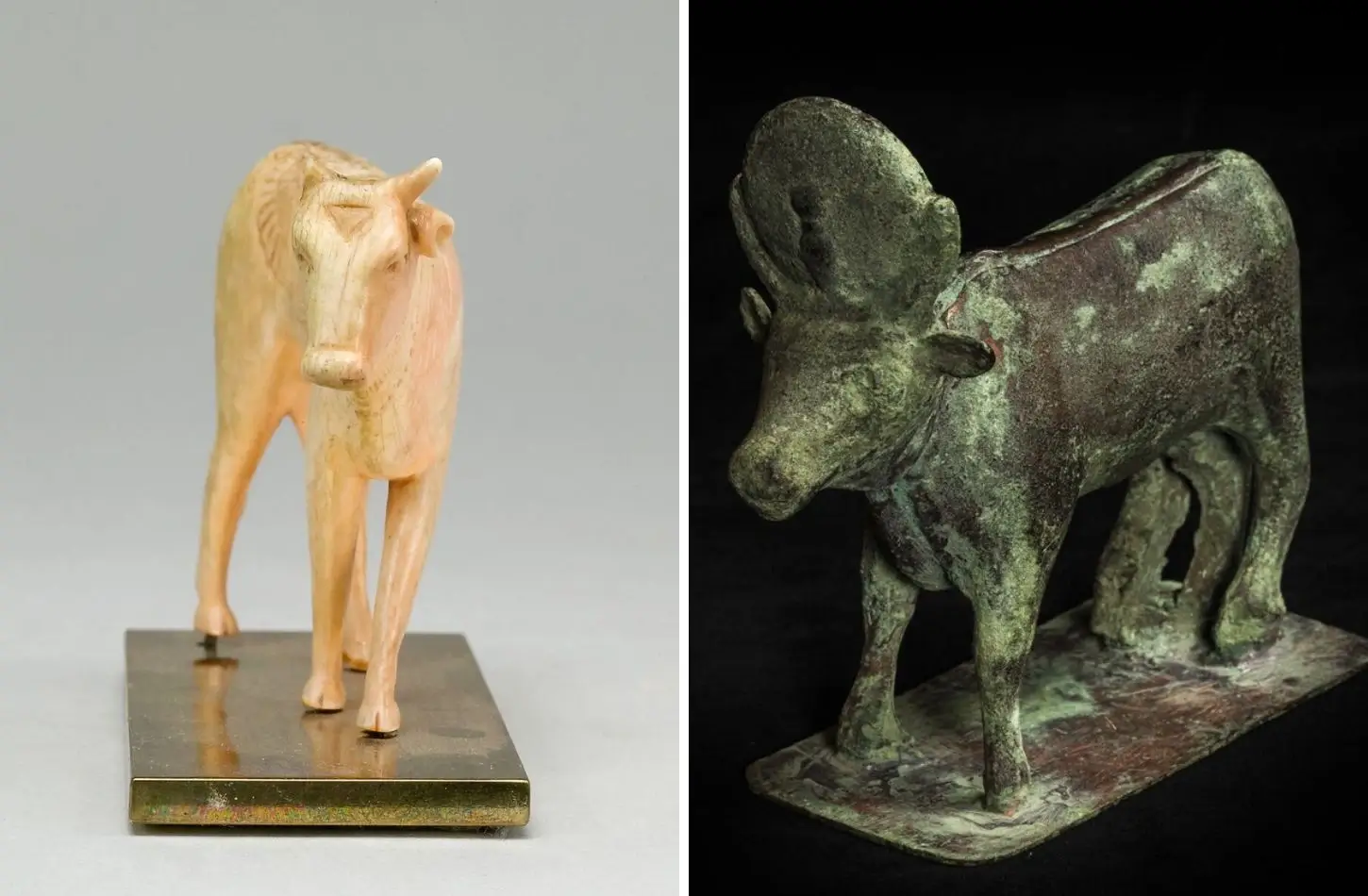
Role: The sacred bull, the earthly embodiment of the god Ptah, and later of Osiris.
Where to see it: The Serapeum at Saqqara and the Egyptian Museum in Cairo.
The Apis bull was unique among the Egyptian animal deities, as only one ever existed. It was identified by specific sacred markings and was believed to be the physical manifestation of the god Ptah on Earth. It lived in luxury in the Temple of Ptah at Memphis, where priests cared for it and consulted it as an oracle.
The required markings were very precise: a white triangle on its forehead, an eagle-shaped mark on its back, a scarab mark on its tongue, and a tail with hair growing in two directions. When the Apis bull died, Egypt entered a period of official mourning. The bull was mummified in a royal ceremony and buried in a massive granite sarcophagus in the underground galleries of the Serapeum at Saqqara.
Where will you see the Apis bull during your trip to Egypt? The Serapeum at Saqqara is one of Egypt’s most magnificent yet least visited archaeological sites. Wandering its rock-carved passageways, past the massive granite sarcophagi that once housed sacred bulls, is a truly awe-inspiring experience. We include a visit to this temple in our extended Saqqara tours for clients who wish to explore sites beyond those covered in traditional Giza tours.
8- Hathor – The Cow
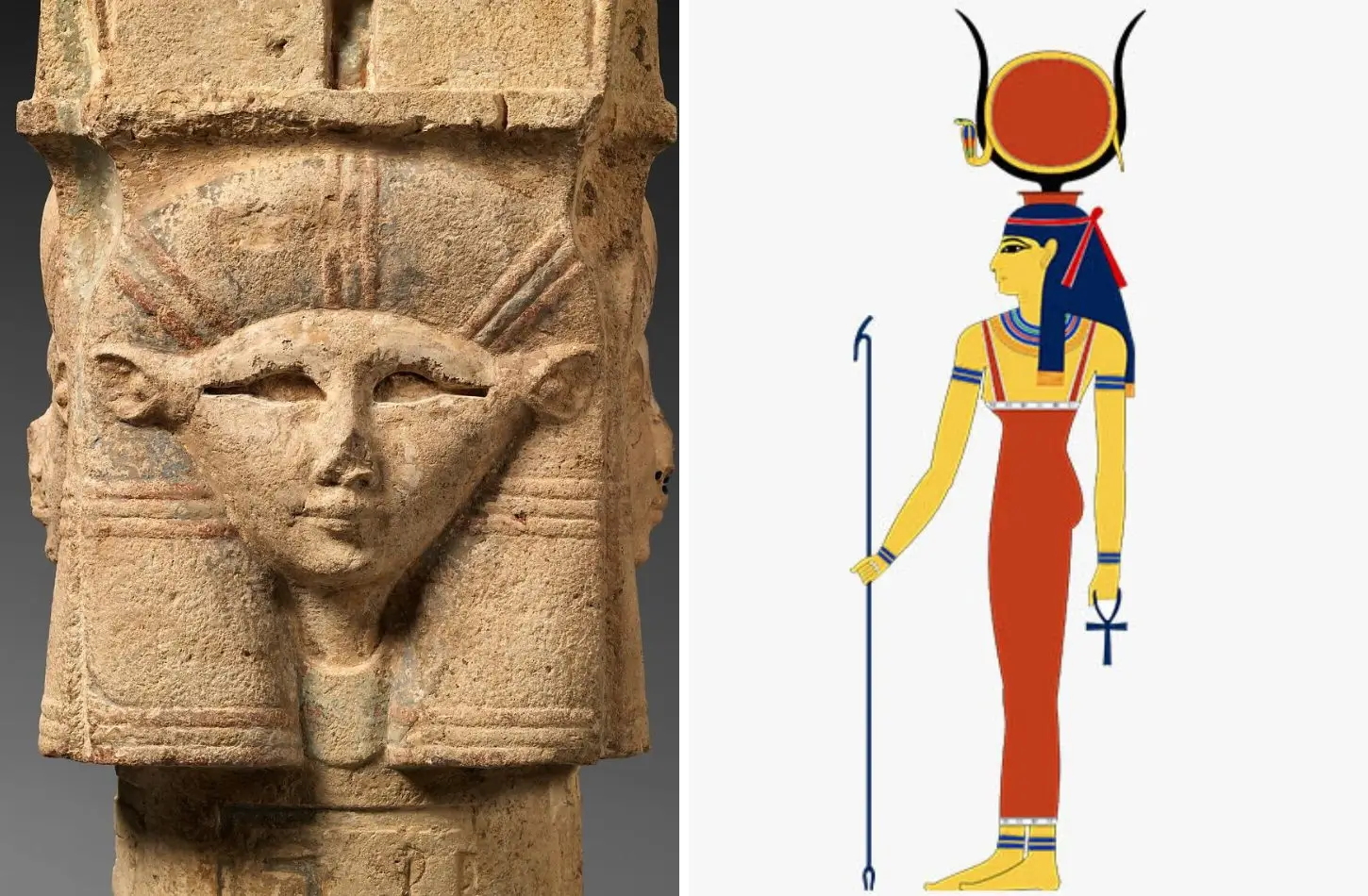
Role: Goddess of love, beauty, music, motherhood, and fertility
Places to see her: Temple of Hathor at Dendera, Egyptian Museum in Cairo, and Abu Simbel
Hathor is one of the oldest and most important goddesses in Egyptian mythology. Depicted as a cow, or a woman with cow’s ears and horns holding the sun disk, she was the goddess of everything that makes life worth living—love, music, dance, beauty, fertility, and the joy of the harvest.
She was the divine mother of the pharaoh, the protector of women during childbirth, and the goddess of the western horizon—welcoming the dead to the afterlife with music and embraces. Her temples were places of celebration and healing, in contrast to the solemnity of Osiris or the ferocity of Sekhmet.
Where you will encounter Hathor on your Egypt trip: The Temple of Dendera, north of Luxor, is one of Egypt’s best-preserved temples and entirely dedicated to Hathor. Its painted ceiling, zodiac reliefs, and Hathor-headed columns make it one of the most atmospheric sites in the country. At Abu Simbel, she features prominently in the temple of Nefertari. Both are included in our Luxor and Aswan tour itineraries.
3Sacred Animals in Egyptian Daily Life
The veneration of Egyptian animal deities wasn’t confined to temples and tombs; it shaped behavior, law, and culture in daily life for thousands of years.
Cats lived in Egyptian homes as family members, were protected by law, and were mourned with rituals. Family members would shave their eyebrows when a cat died. Crocodiles near Nile communities were never attacked; they were carefully monitored, and their presence was considered a sign of the god Sobek. Ibis roamed the streets of Egyptian cities untouched, as it was considered a symbol of the god Thoth.
Mummification became one of the most widespread religious practices in ancient Egypt. At religious centers, animals were specially bred to be offered by pilgrims as sacrifices to the gods—the equivalent of lighting a candle at a shrine. Archaeologists have found millions of animal mummies throughout Egypt: cats at Saqqara, ibises and baboons at Abydos, crocodiles at Kom Ombo, and bulls at the Serapeum.
When I take my clients on a tour through the cat cemetery in Saqqara, knowing that beneath our feet lie the remains of hundreds of thousands of cats sacrificed to the goddess Bastet over a thousand years, it’s difficult to grasp the extent of Egyptian worship. It’s one of those moments that reminds me why Egypt is so unique on Earth.
4Egyptian Gods With Animal Heads — Why the Human-Animal Form?
The question I hear most often at temple sites is this: why did the Egyptians depict their gods as part human, part animal?
The answer lies in what they were trying to communicate. A fully human god is comprehensible but ordinary. A fully animal god is divine but remote. The hybrid form — human body, animal head — expressed something in between: a being present in the human world but possessing qualities no human could contain. The falcon’s vision, the lion’s strength, the crocodile’s dominion over the Nile — the animal head made these qualities immediately visible.
Hieroglyphics worked on the same principle. An image of a falcon could represent the letter “h,” the name Horus, or divine kingship, depending on context. The Egyptians thought visually and theologically at the same time — and the animal-headed god was the purest expression of that thinking.
5Dangerous Animals in Ancient Egypt and Their Divine Significance
Not all sacred animals in ancient Egypt were gentle. Some of the most venerated were also the most dangerous — and understanding why reveals something essential about Egyptian religious thought.
The crocodile was one of the deadliest animals in the Nile Valley. Rather than trying to destroy it, the Egyptians worshipped it. The logic was simple: what you cannot defeat, you honor.
The hippopotamus combined enormous danger with deep religious significance. The male hippo was associated with Set, the god of chaos. But the female became Taweret, goddess of childbirth — her massive body and ferocious maternal protectiveness making her the perfect guardian of women in labor.
The cobra was simultaneously one of the most feared and most sacred creatures in Egypt. The uraeus — the rearing cobra worn on pharaonic crowns — was Wadjet, protective goddess of Lower Egypt. The same snake that could kill with a single bite was the emblem of royal power. The Egyptians did not resolve this contradiction — they embraced it. Danger and protection were always two aspects of the same divine force.
The scorpion was associated with Serqet, the goddess of venom and guide of souls. Her priests were specialists in treating scorpion stings and snake bites — among the earliest toxicologists in recorded history.
6FAQs About Egyptian Animal Gods
What animal is each Egyptian god?
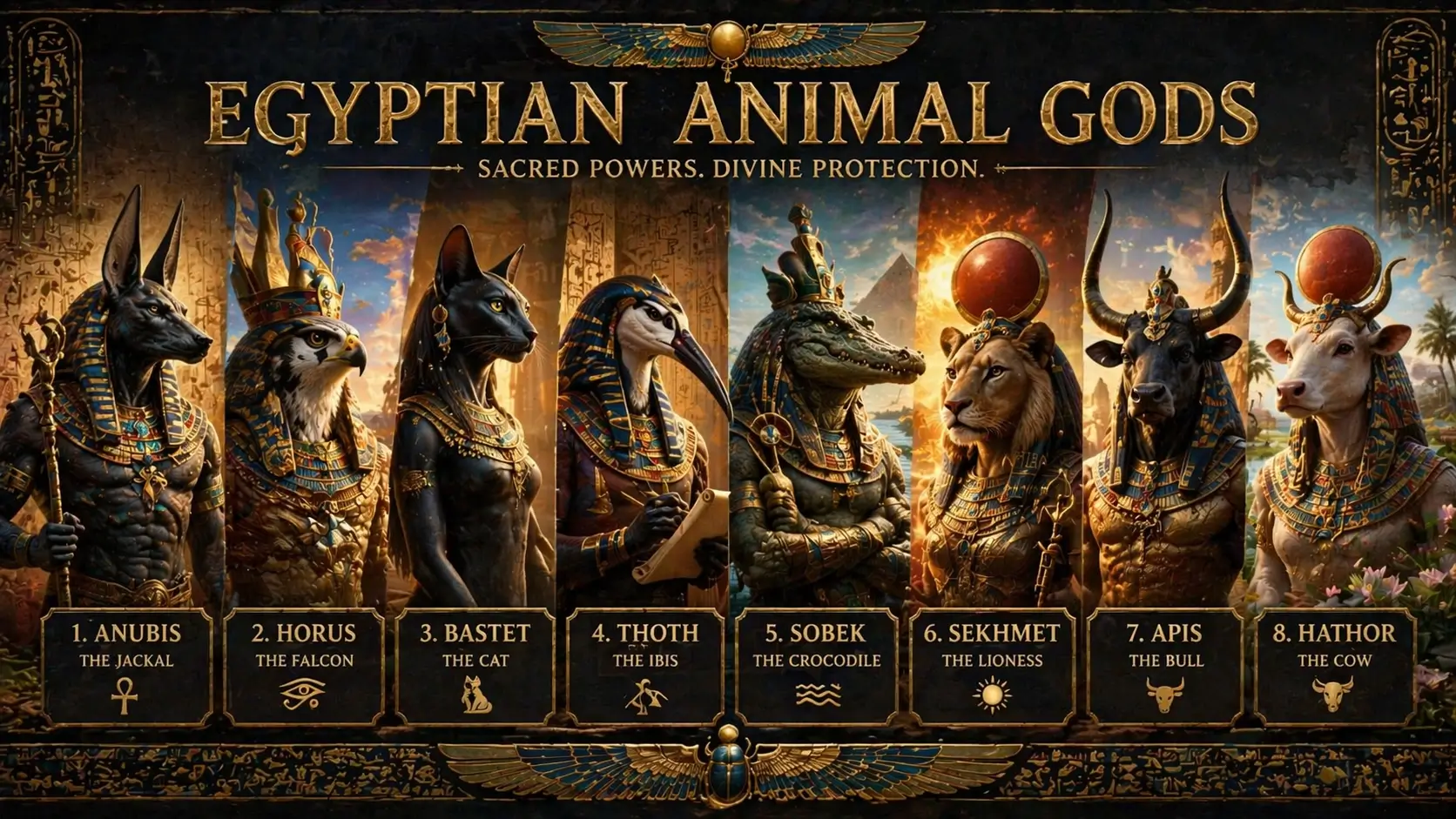
The main Egyptian gods and their animals are: Anubis — jackal, Horus — falcon, Bastet — cat, Thoth — ibis and baboon, Sobek — crocodile, Sekhmet — lioness, Apis — bull, Hathor — cow, Ra — falcon, Set — the sha (a composite creature with no real-world equivalent), Wadjet — cobra, Taweret — hippopotamus, and Serqet — scorpion. Each animal was chosen because its natural qualities reflected the god’s divine role.
What animal is set in Egyptian mythology?
Set is associated with the sha — a mysterious composite animal with a long curved snout, square-tipped ears, and a forked tail that does not match any known creature. Scholars believe it may have been inspired by an aardvark, a donkey, or a long-extinct animal. Set is also sometimes depicted with a donkey or a pig — animals considered impure in certain Egyptian contexts, reflecting his association with chaos and disorder.
What was the most sacred animal in ancient Egypt?
The cat holds a strong claim to being the most widely revered sacred animal — protected by law, mourned with ceremony, and worshipped throughout the country in the cult of Bastet. The Apis bull, however, was treated as the living embodiment of a god during its lifetime and received a burial that rivaled that of pharaohs. Both animals were considered uniquely sacred, though in different ways.
What are the Egyptian livestock gods?
The main gods associated with livestock were Hathor — the cow goddess of fertility and abundance; the Apis bull, the living incarnation of Ptah; Khnum — a ram-headed god associated with the Nile’s creative power; and Bat, an early cow goddess who later merged with Hathor. These gods reflected the central importance of cattle in Egyptian agriculture and daily life.
Why were animals so important in Egyptian religion?
Ancient Egyptians observed animals with deep attention and saw in their behavior qualities that felt divine — the falcon’s precision, the cat’s mystery, the crocodile’s power. They believed that the gods could inhabit animal forms, use animals as messengers, or be physically present in a specific sacred animal. Venerating the animal was a way of maintaining harmony with the god it represented — and, by extension, with the natural and cosmic order on which Egyptian civilization depended.
Can I see Egyptian animal gods when I visit Egypt?
Yes — and this is one of the great privileges of visiting Egypt. The animal gods are depicted in extraordinary detail across the temples and tombs of Luxor, Aswan, Cairo, and Abydos. At Karnak Temple, Edfu, Kom Ombo, Dendera, the Valley of the Kings, the Serapeum at Saqqara, and the Grand Egyptian Museum, these gods are not distant or abstract — they are painted, carved, and sculpted in vivid detail, exactly as the ancient Egyptians intended them to be seen.
7Experience the Egyptian Animal Gods with Egypt Holiday Makers
I have stood in front of the Anubis shrine from Tutankhamun’s treasury, watched the afternoon light move across the falcon statues at Edfu, and seen a client’s face the first time they walk into a painted tomb in the Valley of the Kings and realize every wall is alive with these gods. There is nothing quite like it.
Understanding the animal gods before you arrive transforms what you see. Seeing them in person — in the temples and tombs they were made to inhabit — transforms what you take home.
Our Egypt tour packages cover the full sweep of the country, with every major temple and sacred site included. Our Classic Egypt Tours are designed for first-time visitors who want to encounter the animal gods in their most iconic settings — Karnak, the Valley of the Kings, Saqqara, and the Egyptian Museum. And our all-inclusive Nile River cruises stop at Edfu and Kom Ombo, where Horus and Sobek still preside over temples built in their honor.
Tell us which gods you want to find. We will take you to them.
8Conclusion:
The Egyptian animal gods are not relics of a dead religion. They are still present — painted on temple walls that have stood for three thousand years, carved into tombs sealed with the intention that these images would last forever.
What the ancient Egyptians understood about the natural world and the divine was not primitive. It was a different kind of sophistication — one that found the sacred in the creatures that shared their landscape and built one of history’s greatest civilizations around that vision. Come and see them for yourself.
Ready to plan your Egypt trip? Let's find your perfect dates.
A local expert replies within hours with a tailor-made itinerary and honest advice.