Karnak Temple is one of the most extraordinary monuments ever created by human hands. Located on the east bank of the Nile in Luxor, ancient Thebes, Karnak Temple is not a single building but a vast sacred complex that grew over more than two thousand years. It represents the heart of religious life in ancient Egypt and stands today as the largest religious complex ever constructed.
Dedicated primarily to Amun-Ra, the supreme god of the New Kingdom, also honored other important deities, including Mut and Khonsu. Each generation of pharaohs added to the site, turning Karnak Temple into a layered masterpiece of faith, power, and architectural genius. Walking through its massive gateways and towering columns makes it immediately clear why Karnak Temple remains one of Egypt’s most awe-inspiring attractions.
The Ancient Origins and Evolution of Karnak Temple
The origins of Karnak Temple date back to the Middle Kingdom, around 2000 BCE, when Thebes became an important political and religious center. At that time, the site consisted of a modest sanctuary devoted to Amun, a local god whose influence grew rapidly. As Amun became associated with the sun god Ra, his cult expanded, and Karnak Temple grew alongside his rising importance.
The most dramatic developments at Karnak Temple occurred during the New Kingdom. Powerful rulers such as Hatshepsut, Thutmose III, Seti I, and Ramses II transformed the temple into a monumental complex. Each pharaoh contributed new pylons, courts, obelisks, and halls to demonstrate devotion to the gods and reinforce royal authority. Rather than replacing earlier structures, new additions were built around existing ones, creating a complex historical record carved in stone.
Karnak Temple continued to be used and modified long after the New Kingdom. Later dynasties, including Nubian and Ptolemaic rulers, restored sections of the temple and added new elements. Even as political power shifted, Karnak Temple remained a sacred center for centuries, making it one of the longest continuously developed religious sites in the world.
The Purpose of Karnak Temple
The primary purpose of Karnak Temple was to serve as the main cult center of Amun-Ra. Daily rituals performed by priests were believed to sustain the god and maintain harmony in the universe. These rituals included offerings, prayers, music, and symbolic acts meant to preserve Ma’at, the divine order that governed all life in ancient Egypt.
Unlike modern places of worship, Karnak Temple was not open to the general public. Most sacred areas were accessible only to priests and the pharaoh, who was considered the gods’ earthly representative.
Karnak Temple also played a vital political role. Reliefs carved into its walls show pharaohs presenting offerings to the gods, defeating enemies, and receiving divine approval. These scenes reinforced the idea that the ruler’s power was granted by the gods themselves. In this way, Karnak Temple was both a religious sanctuary and a powerful statement of royal legitimacy.
The Monumental Architecture of Karnak Temple
The architecture of Karnak Temple is remarkable for its immense scale and symbolic design. Covering more than 200 acres, the complex includes multiple precincts, with the largest dedicated to Amun-Ra. The temple’s layout follows a sacred axis that reflects the journey from the human world to the divine realm.
Massive pylons mark each stage of this journey, growing more restricted and sacred as one moves deeper into the complex. This architectural progression was meant to guide worshippers spiritually as well as physically.
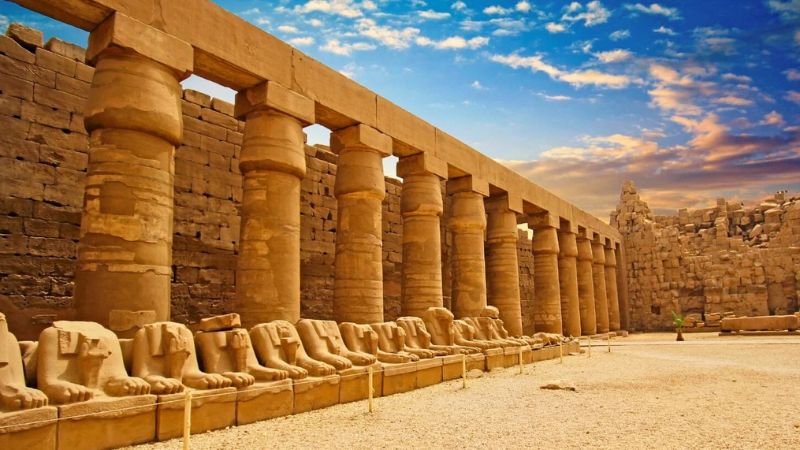
The most famous architectural feature of Karnak Temple is the Great Hypostyle Hall. Built mainly by Seti I and Ramses II, this vast hall contains 134 massive columns arranged in orderly rows. The tallest columns rise over 20 meters high and are decorated with detailed reliefs and hieroglyphs.
Light enters the hall through stone grills near the ceiling, creating a dramatic contrast of shadow and illumination. The effect is overwhelming and gives visitors a sense of the power and grandeur that ancient worshippers must have felt.
Karnak Temple is home to some of the tallest obelisks ever erected in Egypt, including those commissioned by Queen Hatshepsut. These towering granite monuments symbolized the sun’s rays and the eternal connection between the gods and the pharaoh. Their precision and scale demonstrate the advanced engineering skills of ancient Egyptian builders.
The Interior Design and Ritual Spaces
The interior of Karnak Temple was carefully designed to reflect religious beliefs. As visitors moved inward, ceilings became lower, lighting dimmer, and access more restricted. The innermost sanctuary once housed the sacred statue of Amun-Ra and was the most holy space within the complex.
Walls throughout the interior are covered with scenes of rituals, offerings, and divine encounters. These carvings were believed to hold magical power, ensuring that rituals would continue eternally through their depiction.
One of the most peaceful features within is the sacred lake. Priests used this large body of water for ritual purification before performing ceremonies. The lake symbolized the primeval waters of creation and added a reflective, spiritual dimension to the temple environment.
Fascinating Facts About Karnak Temple
Karnak Temple is the largest religious complex ever built, shaped by the efforts of more than thirty pharaohs. Some of the stones used in its construction weigh over seventy tons, transported and lifted with remarkable precision. The temple was once brightly painted in vivid colors, traces of which can still be seen today.
Another impressive feature is the alignment of certain structures with astronomical events, showing how closely religion, science, and architecture were connected in ancient Egypt.
Major Attractions Around Karnak Temple
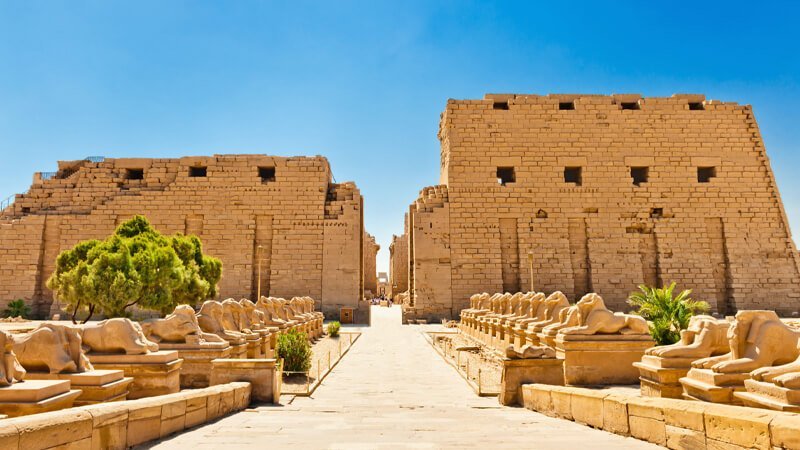
Karnak Temple is surrounded by important attractions that enrich the visitor experience and provide deeper insight into ancient Thebes. One of the most striking connected features is the Avenue of Sphinxes, a ceremonial road that once linked to Luxor Temple. Lined with ram-headed sphinx statues, this avenue was used during grand religious festivals when statues of the gods were carried in procession.
Within the complex itself, the Open-Air Museum is a major highlight. This area contains reconstructed chapels and monuments, including the White Chapel of Senusret I and the Red Chapel of Queen Hatshepsut. These structures reveal how earlier temples were dismantled and reused, offering a unique look at ancient construction techniques and religious changes.
A short distance to the south lies Luxor Temple, another essential attraction connected to. While it served as the main religious center, Luxor Temple was associated with royal renewal and divine kingship. Visiting both temples provides a more complete understanding of ancient Egyptian religious life.
Nearby, the Luxor Museum offers beautifully displayed artifacts discovered at Karnak Temple and other local sites. Statues, reliefs, and inscriptions displayed in the museum help visitors place within its broader historical context.
Across the Nile on the West Bank, attractions such as the Valley of the Kings and the Temple of Hatshepsut further complement a visit to Karnak Temple. These sites demonstrate how beliefs practiced at Karnak influenced royal burials and monumental architecture, completing the picture of ancient Egyptian civilization.
Karnak Temple in Ancient Daily Life
Karnak Temple was not a silent place in ancient times. It was filled with music, incense, chanting, and ceremony. Festivals such as the Opet Festival brought the gods out of their sanctuaries and into the streets, allowing the public to witness sacred rituals. These celebrations reinforced social unity and renewed the bond between gods, king, and people.
Priests held immense influence. They oversaw daily rituals, managed temple lands, and maintained strict purity rules. Their work ensured that the gods were honored correctly, which was believed to directly affect the prosperity of Egypt.
The Temple Today
Today, it is a UNESCO World Heritage Site and one of Egypt’s most visited landmarks. Visitors can explore its vast courtyards, towering columns, and sacred spaces while gaining a powerful sense of ancient history. Ongoing restoration continues to reveal new details about the temple’s past.
Evening sound and light shows bring it to life through storytelling and illumination, offering a different and memorable way to experience its grandeur.
Conclusion
Karnak Temple stands as one of humanity’s greatest achievements. Through its long history, sacred purpose, monumental architecture, richly decorated interior, and surrounding attractions, it offers a deep and unforgettable insight into ancient Egyptian civilization. More than just ruins, it remains a powerful symbol of faith, creativity, and enduring human ambition.